
What you’ll learn in this article…
- DC metro counselors earn well above the national median salary, reflecting high demand and cost of living.
- CACREP accreditation and specialization track determine which of three jurisdictions (DC, Maryland, Virginia) you can get licensed in fastest.
- Tuition across DC counseling programs varies significantly, making total cost comparison essential before committing.
- Licensure as an LPC in the DC metro typically requires 3 to 4 years from your first graduate class to full credentials.
Licensure portability has become a defining concern for counselors training in the Washington, DC metro, where graduates routinely cross between the District, Maryland, and Virginia for jobs, supervision, or clients. The region's counseling programs reflect this reality: a small but distinctive set of CACREP-accredited and regionally accredited counseling degrees, each shaped by the capital's concentration of federal agencies, advocacy organizations, and community mental health centers.
The practical tension is real. DC's programs offer unmatched practicum access, but tuition runs high and each jurisdiction enforces its own post-degree supervision and exam requirements. Graduates who plan poorly can face months of credential delays when crossing state lines.
Best Counseling Master's Programs in Washington, DC
Washington, DC offers a counseling-education landscape unlike any other metro area. Students here can complete practicum hours at federal agencies, advocacy organizations, and policy-adjacent nonprofits while building a professional network that spans three jurisdictions. Because DC, Maryland, and Virginia each maintain separate licensure boards, choosing a CACREP-accredited program simplifies the path to becoming a Licensed Professional Counselor across all three. The programs below range from research-intensive universities to mission-driven institutions serving specialized populations, so the right fit depends on your clinical interests, budget, and schedule.
- CACREP accreditation and standards alignment
- Graduate debt and institutional cost
- Institutional earnings outcomes
- Program format and scheduling flexibility
- Specialized populations and clinical focus
- NCES-IPEDS federal institutional data — nces.ed.gov
- College Scorecard graduate earnings — collegescorecard.ed.gov
- Internal program database
- Independent program research

George Washington University
George Washington University houses three CACREP-accredited counseling tracks, giving students a rare opportunity to specialize in clinical mental health, school counseling, or rehabilitation counseling at the same institution. Evening classes at the Alexandria campus and supervised placements across DC-area schools, government entities, and community agencies make the program practical for working professionals. The clinical mental health track reports strong recent outcomes, including a 93% retention rate and 95% employment within six months of graduation. Tuition runs higher than other DC options, but GW's institutional median graduate debt of roughly $20,400 suggests robust financial aid offsets some of that sticker price.
- CACREP-accredited with on-campus delivery in Washington, DC
- Supervised placements at urban and suburban health and human service agencies
- 93% program retention rate and 2.6-year average completion time
- 95% of recent graduates employed within six months
- Graduates eligible for LPC licensure in DC, Maryland, and Virginia
- Application fee waived; priority deadlines for summer and fall starts
- CACREP- and CAEP-accredited 60-credit program
- Evening classes two nights per week at the Alexandria, VA campus
- Cohort model with practicum and internship in K-12 settings
- Graduates eligible for Certified School Counselor and LPC credentials
- Potential pathway to Registered Play Therapist designation
- No application fee; faculty interview required for admission
- CACREP-accredited 60-credit on-campus program
- Focused on disability, vocational, and psychosocial rehabilitation
- Clinical training in DC-area rehabilitation and community agencies
- Prepares graduates for Certified Rehabilitation Counselor credential
- Serves a growing need in federal disability services in the metro area
- Hands-on practicum integrated throughout the curriculum
Master of Arts in Clinical Mental Health Counseling — On-Campus
Master of Arts in School Counseling — On-Campus
Master of Arts in Rehabilitation Counseling — On-Campus

Trinity Washington University
Trinity Washington University pairs an affordable tuition structure with CACREP-accredited counseling programs delivered in evening and hybrid formats. Both the school counseling and clinical mental health counseling tracks require 60 credits and a 700-hour combined practicum and internship, preparing graduates for licensure across DC, Maryland, and Virginia. The university's institutional net price of roughly $9,300 is among the lowest of any private school in the District, though median graduate debt at the institutional level is approximately $28,250, so prospective students should investigate scholarship opportunities carefully. Trinity's social-justice-centered curriculum and small 9:1 student-to-faculty ratio support close mentorship throughout the program.
- CACREP-accredited 60-credit hybrid program
- Evening and online course options for working professionals
- 700-hour practicum and internship in PK-12 settings
- Designed for DC, Maryland, and Virginia school counselor certification
- Admission requires 2.8 GPA, personal essay, and interview
- Small class sizes with a 9:1 student-to-faculty ratio
- CACREP-accredited 60-credit hybrid program
- Evening and hybrid scheduling to accommodate full-time workers
- 700-hour supervised clinical practicum requirement
- Social justice and equity woven into the core curriculum
- Multiple clinical partner sites across the DC metro area
- Graduates eligible for LPC licensure in three jurisdictions
Master of Arts in School Counseling — Hybrid
Master of Arts in Clinical Mental Health Counseling — Hybrid

University of the District of Columbia
As DC's only public university and a historically Black institution, the University of the District of Columbia offers the metro area's most affordable in-state graduate tuition for counseling. The CACREP-accredited M.S. in Counseling with a school counseling concentration provides a dual-licensure advantage: graduates can pursue both school counselor certification and LPC licensure. An 8:1 student-to-faculty ratio ensures individualized attention, and fieldwork is embedded in DC's diverse public and charter school landscape. In-state graduate tuition is approximately $9,600 per year, making UDC a strong option for District residents looking to minimize debt.
- CACREP-accredited program with dual licensure pathway
- 100-hour practicum plus 600-hour internship in K-12 settings
- In-state graduate tuition of roughly $9,600 per year
- 8:1 student-to-faculty ratio for close faculty mentorship
- Crisis intervention and leadership training integrated into coursework
- Admission requires a 3.0 GPA and relevant prerequisite coursework
Master of Science in Counseling, School Counseling Concentration — On-Campus

Howard University
Howard University's counseling psychology doctorate is rooted in a scientist-practitioner model with a pronounced emphasis on multicultural resilience and mental health disparities. As an HBCU with a nationally recognized research profile, Howard attracts students committed to advancing equity in psychological practice. The 108-credit Ph.D. is a full-time, on-campus commitment, and the GRE is optional for admission. Institutional-level median graduate debt sits near $24,500, while median earnings ten years after enrollment reach roughly $63,100, reflecting the advanced credential's earning power.
- 108-credit full-time, on-campus doctoral program
- Scientist-practitioner model with multicultural counseling focus
- GRE optional; requires three recommendation letters
- Supervised clinical and research training in diverse settings
- Dissertation contributing original research to the profession
- Graduates eligible for psychology licensure nationally
Doctor of Philosophy in Counseling Psychology — On-Campus

Gallaudet University
Gallaudet University is the world's only university designed for deaf and hard-of-hearing students, and its counseling programs channel that mission into a distinctive clinical niche. The M.A. in Counseling offers both school counseling and clinical mental health tracks in a three-year hybrid format combining summer residencies with online coursework. Conversational ASL fluency is an admissions requirement, and graduates leave prepared to serve deaf, hard-of-hearing, and hearing clients, filling a critical workforce gap in the DC metro's extensive network of deaf-serving schools and agencies. With a median institutional graduate debt of about $18,000, Gallaudet carries the lowest debt figure among the private institutions on this list.
- 61-credit hybrid program spanning three years
- Summer residencies combined with online coursework
- 600-hour internship in K-12 school counseling settings
- Aligned with CACREP standards for accreditation readiness
- Prepares counselors for deaf, hard-of-hearing, and hearing students
- ASL proficiency required at admission; financial support available
- Three-year hybrid format with summer residency components
- 600-hour clinical mental health internship
- Deaf-centered counseling approach with multicultural emphasis
- Trains graduates for LPC-eligible roles across the DC metro
- ASL proficiency required; bilingual clinical competency developed
- Lowest median institutional graduate debt among DC private schools
M.A. in Counseling: School Counseling — Hybrid
M.A. in Counseling: Clinical Mental Health Counseling — Hybrid

The Chicago School at Washington DC
The Chicago School of Professional Psychology anchors its Washington, DC campus identity to an online Ph.D. in Counselor Education and Supervision designed for licensed counselors ready to teach, supervise, or lead. The CACREP-accredited doctorate requires two in-person residencies, which are especially convenient for students already living in the DC metro area. With 100 practicum hours and 600 internship hours built into the curriculum, graduates gain hands-on experience in teaching and clinical supervision. Median institutional graduate debt is approximately $20,000, and the program's online delivery lets working counselors across the region advance without leaving their current caseloads.
- CACREP-accredited online doctorate with DC campus affiliation
- Two required in-person residencies convenient for metro residents
- 100 practicum hours and 600 internship hours
- Dissertation required contributing original counseling research
- Minimum 3.0 GPA and three recommendation letters for admission
- Designed for licensed counselors seeking educator or leadership roles
Ph.D. in Counselor Education and Supervision — Online
How We Ranked These DC Counseling Programs
Some program rankings rely on reputation surveys or editorial opinion, while others ground their methodology in verifiable federal data. The list you see on counselingpsychology.org follows the second approach, drawing exclusively from the U.S. Department of Education's College Scorecard to produce rankings that readers can check for themselves.
What the Rankings Measure
Four weighted factors determine each program's position:
- Median earnings after graduation: What graduates actually earn in the years following completion, reported directly to federal databases through tax records.
- Student debt load: The typical borrowing required to finish the program, which directly affects a graduate's financial flexibility when entering the counseling workforce.
- Program cost: Total tuition and fees, giving prospective students a realistic sense of investment before they apply.
- Completion rates: The share of students who finish within the expected timeframe, signaling both program support structures and realistic workload expectations.
These metrics matter because they reflect outcomes students can verify independently. Unlike competitor sites that often blend proprietary algorithms with undisclosed weighting, this methodology lets you trace every factor back to public federal data.
What the Rankings Do Not Capture
No ranking system measures everything that matters. This approach does not evaluate clinical training quality, faculty research productivity, practicum site relationships, or student satisfaction scores. Those elements shape your day-to-day experience and professional development in ways that federal data cannot quantify. If you are still exploring broader options, our guide to best online master's in counseling programs can help you compare schools nationwide. Prospective students should also weigh qualitative factors through campus visits, informational interviews with current students, and direct conversations with program faculty.
A Note on CACREP Accreditation
You will see CACREP accreditation status noted throughout this guide, but it does not function as a ranking factor here. Accreditation appears separately so you can filter programs based on your licensure goals. Many states, including those in the DC metro area, either require or strongly prefer CACREP-accredited training for LPC licensure, making it a critical consideration that deserves its own spotlight rather than absorption into a composite score.
Questions to Ask Yourself
Tuition and Total Cost Comparison for DC Counseling Programs
Choosing a counseling program in Washington, DC often comes down to a single uncomfortable tension: the city's programs can deliver exceptional clinical training and career networks, but that access comes at a real cost. Understanding what you will actually pay, before you commit, puts you in a far stronger negotiating position with financial aid offices.
What the Numbers Look Like at GWU
George Washington University is the most thoroughly documented program in terms of public tuition data. All three of its counseling master's programs (Clinical Mental Health Counseling, School Counseling, and Rehabilitation Counseling) required 60 credit hours as of the 2024, 2025 academic year, with a per-credit rate of $1,925.123 That places estimated total tuition in the range of $115,500 before fees, living costs, or any aid. For the 2026, 2027 academic year, GWU's Graduate School of Education and Human Development has published an updated per-credit rate of $2,000 for on-campus programs, which would bring the 60-credit total closer to $120,000 at sticker price.4
These figures are tuition only. Students should budget separately for program fees, clinical placement costs, and DC's above-average cost of living.
Scholarships and Assistantships at GWU
GWU does offer merit-based scholarships across its counseling programs, though award amounts and eligibility criteria are not publicly itemized and vary by cohort.1 The Rehabilitation Counseling track has a notable additional avenue: federal long-term rehabilitation counseling training scholarships, funded through the Rehabilitation Services Administration, which can substantially offset tuition in exchange for a post-graduation service commitment in rehabilitation settings.3 Prospective students interested in that track should ask the department directly about current funding availability and the service obligation terms.
Other DC Programs
Published tuition data for Trinity Washington University, Gallaudet University, and the University of the District of Columbia was not available for direct comparison at the time this article was prepared. Costs at these institutions may differ significantly from GWU, and some, particularly UDC as a public institution, may offer lower per-credit rates for DC residents. Contacting each program's financial aid or admissions office directly remains the most reliable way to build an accurate cost comparison. Students exploring broader options may also want to review clinical mental health counseling online programs to benchmark DC pricing against national alternatives.
Federal Aid and Broader Funding Considerations
All regionally accredited programs in DC are eligible for federal student loans, including unsubsidized graduate loans and, for qualifying students, Grad PLUS loans. Students planning careers in public mental health, nonprofit agencies, or government roles may also qualify for Public Service Loan Forgiveness after meeting the required employment and payment conditions. Graduate assistantships exist at several DC programs, but availability is limited and competitive. Ask each school specifically whether counseling students are eligible, since assistantship pools are sometimes restricted to doctoral students.
Counseling Specializations Available in DC
Which DC counseling programs offer school counseling or rehabilitation tracks, and which stick to clinical mental health only? The answer matters because your specialization determines both your coursework and the credential you can pursue after graduation.
Clinical Mental Health Counseling: The Default Track
Clinical mental health counseling (CMHC) is the most common LPC-qualifying track in DC and the default offering at every program in the city. It is built to align with CACREP standards and the 60-credit threshold most states (including DC) require for licensure as a licensed professional counselor.1
- George Washington University: Master of Arts in Education and Human Development in the Field of Clinical Mental Health Counseling, 60 credits, CACREP-accredited, with 100 practicum hours and 600 internship hours. GWU does not currently run separate school or rehabilitation tracks on its DC campus.
- University of the District of Columbia: M.S. in Counseling, Clinical Mental Health Counseling concentration, CACREP-accredited, 3.0 minimum GPA for admission.
- Trinity Washington University: Master of Arts in Clinical Mental Health Counseling, with a community counseling orientation that emphasizes underserved DC populations.
School Counseling and Rehabilitation Tracks
UDC is the program in the District that offers all three traditional tracks under one roof.2 Beyond its CMHC concentration, UDC runs an M.S. in Counseling, School Counseling concentration (which leads to school counselor certification rather than LPC licensure and follows a different career path into K-12 settings), and an M.S. in Counseling, Rehabilitation Counseling concentration (admission GPA minimum 2.7), aimed at students who want to work with clients with disabilities in vocational and community rehab settings.
Niche Concentrations That Differentiate DC
Gallaudet University's M.A. in Counseling, Clinical Mental Health Counseling carries a built-in niche found at very few programs nationally: it prepares bilingual ASL-English counselors to serve deaf, hard-of-hearing, and deafblind clients.3 The program is delivered online with an on-campus summer residency. Trinity's community counseling emphasis, while housed inside its CMHC degree, similarly distinguishes it from more clinically generic tracks elsewhere.4
Online vs. On-Campus Counseling Programs in DC
Choosing between online, hybrid, and on-campus formats is one of the most consequential decisions you will make when selecting a counseling master's program in the DC metro. The right format depends on your work schedule, your budget for housing in one of the nation's most expensive metros, and how much you value proximity to DC's unmatched clinical training network. Here is a practical breakdown of the trade-offs.
Pros
- On-campus students can tap DC's unique practicum ecosystem, including VA hospitals, federal behavioral health agencies, and a dense network of community mental health nonprofits.
- In-person cohorts tend to build stronger peer support systems, which matter in a field where consultation and professional networking drive early career growth.
- Faculty mentorship is more accessible on campus, with spontaneous advising conversations and research collaboration that online formats rarely replicate.
- Online and hybrid formats offer real flexibility for working professionals, with evening course scheduling that allows you to maintain employment during your program.
- Hybrid learners can live outside the District, potentially in lower cost areas of Maryland or Virginia, and commute into DC only for required practicum hours or intensive weekends.
- George Washington University and Georgetown University offer hybrid or evening friendly counseling tracks, giving students structured flexibility without a fully asynchronous experience.
Cons
- Full relocation to DC means confronting some of the highest housing and cost of living expenses in the country, which can add tens of thousands of dollars to your total program cost.
- On-campus programs typically require daytime availability for at least some coursework and clinical placements, limiting your ability to work full time.
- Fully online programs may have fewer established practicum partnerships with DC area clinical sites, potentially requiring you to arrange your own placements.
- Online students sometimes report feeling disconnected from local professional networks, which can slow the job search process after graduation.
- Hybrid formats still require periodic in-person attendance, so students living far from DC should plan for travel costs and schedule disruptions during intensive residency weeks.
Related Articles
Licensure Pathways: Becoming an LPC in DC, Maryland, and Virginia
Earning your counseling degree in Washington, DC, opens doors across three jurisdictions, but each has distinct licensure requirements that can delay or accelerate your path to independent practice.
How to Become a Therapist in DC
To practice as a licensed professional counselor in the District of Columbia, you must complete a 60-semester-hour master's degree that includes at least 700 hours of supervised fieldwork (100 practicum hours with 40 direct service hours and 600 internship hours with 240 direct service hours).1 After graduation, you will accumulate 3,500 hours of post-degree supervised clinical experience, delivered at a ratio of one hour of supervision for every 35 client-contact hours.2 At least 100 of your supervision hours must be individual face-to-face sessions, and the total supervision must include a minimum of 200 hours. During this period, which typically spans two to five years, you must pass the National Counselor Examination, the National Clinical Mental Health Counseling Examination, or the Certified Rehabilitation Counselor exam.2 Once your supervised hours are complete and your exam scores are on file, you submit an application and pay an $85 application fee plus a $145 initial license fee to the DC Board of Professional Counseling.2
Comparing DC, Maryland, and Virginia Requirements
Maryland's Licensed Clinical Professional Counselor credential requires 3,000 post-master's supervised hours, slightly fewer than DC, and accepts both the NCE and NCMHCE. Virginia's LPC pathway also mandates 3,400 supervised hours (including 200 hours of direct supervision) and accepts the same two national exams. All three jurisdictions prefer CACREP-accredited degrees but do not require them outright.3 However, graduates of non-CACREP programs often face additional transcript reviews to verify that coursework covers core areas such as psychopathology, career development, and multicultural counseling. These reviews can extend your application timeline by several months.
Portability and the Counseling Compact
DC joined the Counseling Compact in 2025, enabling LPCs licensed in member states to practice across state lines via a single multistate license.4 Maryland and Virginia also participate in the Compact, so a DC LPC who meets the Compact's eligibility criteria can provide telehealth or temporary in-person services in either neighboring jurisdiction without applying for a separate credential. DC also offers licensure by endorsement for counselors already licensed in another state, streamlining the process if you relocate after earning your initial credential.3 CACREP accreditation remains the gold standard for portability: when your degree comes from a CACREP program, transcript reviews are faster and reciprocity provisions are broader across all three jurisdictions.
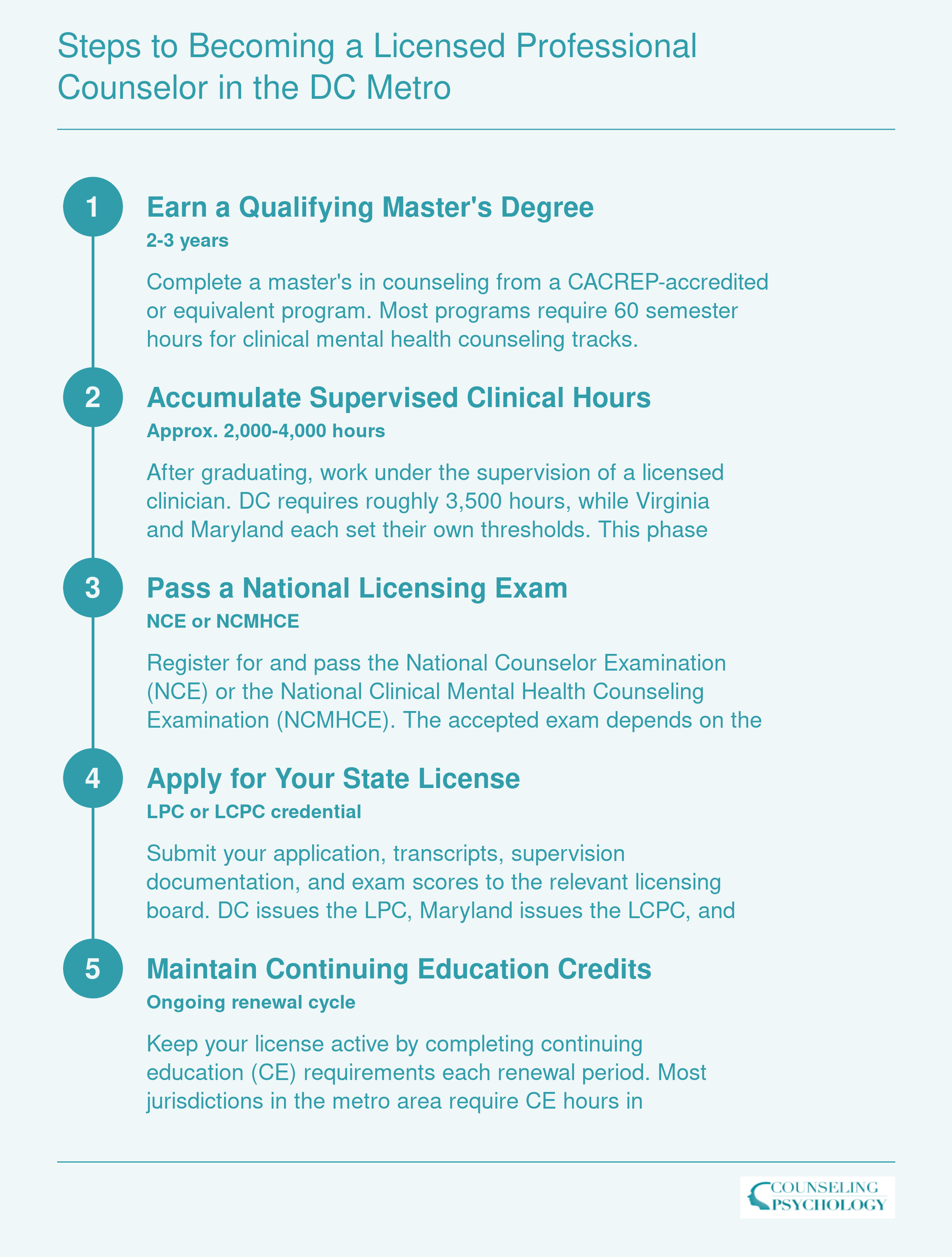
Steps to Becoming a Licensed Professional Counselor in the DC Metro
From your first graduate class to holding a full license, the credentialing journey in the DC metro area typically spans 3 to 4 years. The sequence below applies broadly across DC, Maryland, and Virginia, though specific hour requirements and accepted exams vary by jurisdiction.
Career Outcomes and Salary for Counseling Graduates in the DC Metro
Where you build your counseling career can shape both your earning potential and the types of roles available. The Washington, DC metro area offers some of the nation's highest salaries for mental health professionals, but that comes with a competitive job market and a higher cost of living. In contrast, smaller markets may offer a faster path to building a caseload, though at more modest pay scales. Understanding the local landscape helps you weigh immediate opportunities against long-term growth.
What You Can Earn in the DC Metro
For mental health counselors in the Washington-Arlington-Alexandria metro area, the median annual wage was $63,170 as of May 2024.1 That is about $4,000 above the national median of $59,190.2 The pay range is wide: the lowest 10 percent earned $44,820, while top earners reached $105,530.1 These figures reflect the demand for skilled clinicians in a region that houses federal agencies and large healthcare networks. While the median wage is strong, new graduates should anticipate starting salaries typically closer to the 25th percentile ($50,280) as they work toward independent licensure.
Common Roles and Hiring Organizations
Graduates of master's in counseling programs in DC step into a variety of positions, including:
- Licensed Professional Counselor (LPC): Providing individual and group therapy in private practice, agencies, or hospitals
- School Counselor: Supporting academic and social-emotional development in K-12 settings
- Substance Abuse Counselor: Working in outpatient or residential treatment programs
- Behavioral Health Specialist: Delivering case management and crisis intervention services
For a broader look at the field, our overview of counseling careers covers dozens of specializations and their typical trajectories. Major employers that hire counseling graduates across the region include:
- Federal agencies: The Department of Veterans Affairs (VA), SAMHSA, and the Department of Defense (DOD) all employ counselors to support military personnel, veterans, and public health initiatives
- Hospital systems: MedStar Health and Inova Health System integrate behavioral health into primary and specialty care
- Community mental health centers: These clinics provide accessible care and often serve as training sites for new counselors
- School districts: District of Columbia Public Schools (DCPS) and surrounding counties employ school counselors and mental health specialists
A Promising Growth Outlook
The demand for mental health services continues to rise. Nationally, the BLS projects employment of substance abuse, behavioral disorder, and mental health counselors to grow 17 percent from 2024 to 2034, much faster than the average for all occupations.2 Locally, state projections from 2016 to 2026 estimated a 20.99 percent increase in DC metro mental health counselor jobs, with about 593 annual openings.3 Federal behavioral health funding and the ongoing expansion of integrated care models further elevate demand in the region. While competition for prized federal and hospital positions can be steep, counselors who earn the required DC, Maryland, or Virginia licensure will find sustained opportunity in one of the country's most concentrated behavioral health job markets. Students interested in community-based work can learn more about how to become a community mental health counselor to prepare for roles at these high-demand clinics.
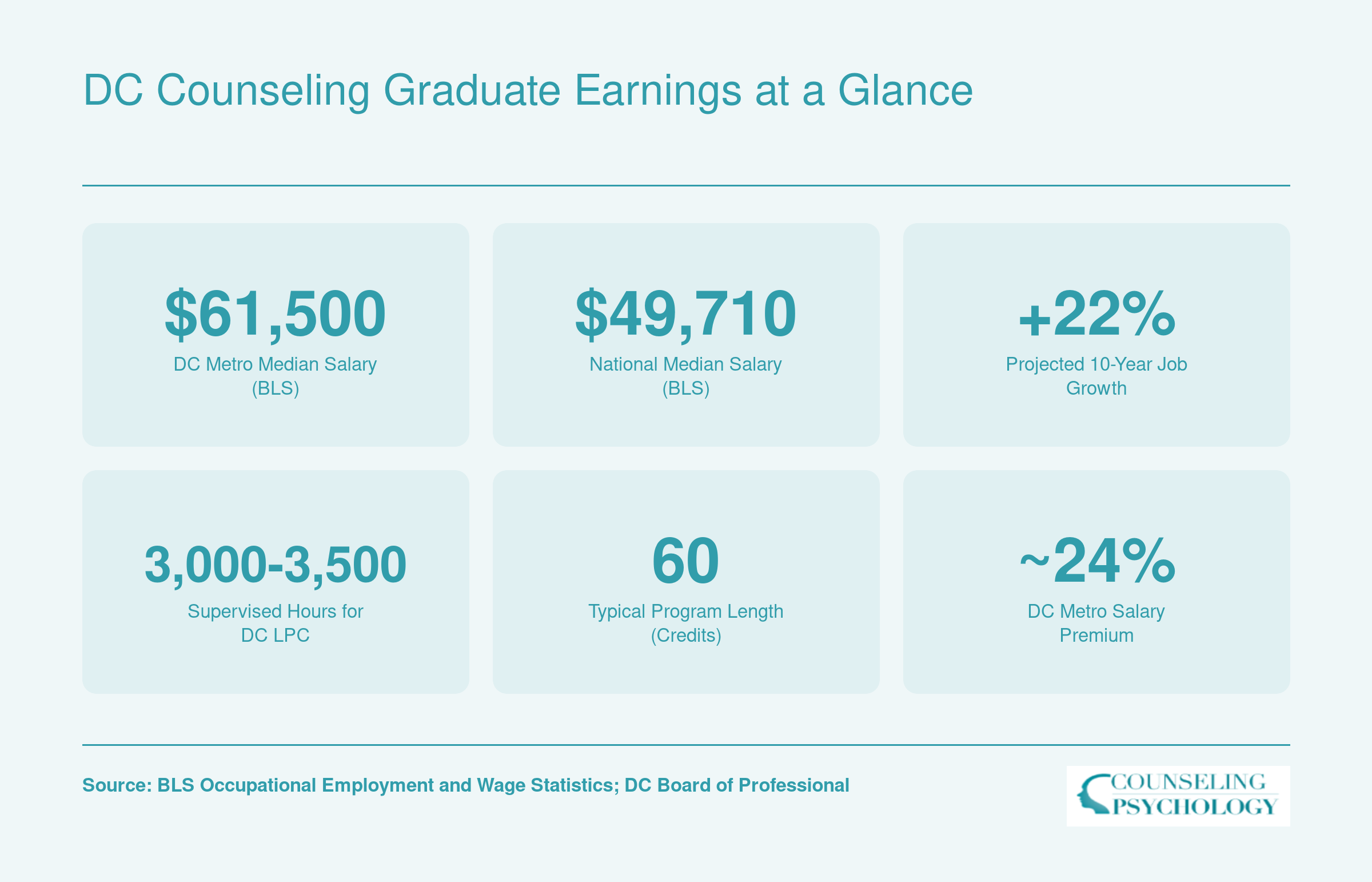
DC Counseling Graduate Earnings at a Glance
Counseling professionals in the Washington, DC metro area typically earn well above the national median, reflecting the region's high demand for mental health services, cost of living, and concentration of federal and nonprofit employers. These figures offer a snapshot of what graduates can expect as they plan their education and early careers.
Frequently Asked Questions About Counseling Programs in DC
Prospective students in the DC metro area often share similar questions about program quality, cost, and the path to licensure. Below are answers grounded in current program data and accreditation records to help you plan your next steps with confidence.