
Key Takeaways
- Wisconsin LPC candidates must complete 3,000 supervised hours, including 1,000 direct client-contact hours, before independent practice.
- CACREP-accredited programs streamline multistate license portability and meet more employer hiring criteria across the field.
- Several Wisconsin schools now offer dedicated child and adolescent counseling tracks available in online or hybrid formats.
- Targeted scholarships, federal loan repayment programs, and wide tuition variation make careful cost comparison essential before enrolling.
What actually separates a master's in counseling that leads to a Wisconsin license from one that costs you extra time and money? The eight programs ranked here include net prices ranging from $12,220 at UW-Superior to $36,201 at Concordia University-Wisconsin, with multiple fully online and hybrid options designed for working adults. Demand for counselors is rising, especially in child and adolescent settings, and several schools now offer dedicated youth-focused specializations. Wisconsin's licensure path requires 3,000 supervised hours, so picking a program with strong practicum placements and CACREP alignment matters from day one. Students drawn to younger populations can also explore how to become a child counselor as they weigh specialization options.
Best Online Master's in Counseling Programs in Wisconsin, 2026 Rankings
These 2026 rankings weight affordability and online or hybrid availability heavily, making them especially useful for Wisconsin residents balancing work, family, and graduate study. Each school listed below offers at least one counseling program that can be completed primarily online or in a flexible hybrid format. Graduation rates shown are institution-wide figures, not specific to any single counseling program.
- Affordability and net price
- Online or hybrid availability
- Institutional graduation and retention
- Graduate debt levels
- Program-level features and outcomes
- Internal program database
- Independent program research
- NCES-IPEDS federal institutional data — nces.ed.gov
- College Scorecard graduate earnings — collegescorecard.ed.gov

University of Wisconsin-Superior
UW-Superior stands out as the most affordable public option on this list, offering both its clinical mental health and school counseling master's tracks entirely online at a flat total tuition of roughly $31,200. The programs are designed so students in rural Wisconsin or northern Minnesota can complete supervised practice hours locally rather than relocating. Licensure preparation covers both Wisconsin and Minnesota, a rare dual-state benefit enabled partly by the long-standing WI-MN tuition reciprocity agreement.
- 100% online, completable in 24 months
- 60-credit curriculum with 600 internship hours
- Total tuition approximately $31,200
- No prior teaching license required
- Prepares for Wisconsin and Minnesota school counselor licensure
- Higher Learning Commission accredited institution
- 100% online with no GRE requirement
- 60 credit hours, 700 clinical practice hours
- Designed to meet Wisconsin LPC academic requirements
- Also prepares graduates for Minnesota licensure
- Minimum 2.75 GPA for admission
- Flat-rate total tuition around $31,200
Master of Science in Education, Counseling (School Counseling Track) — Online
Master of Science in Education, Counseling (Clinical Mental Health Track) — Online

Marquette University
Marquette is the only Wisconsin-based institution offering a CACREP-accredited clinical mental health counseling master's degree in a fully online format, a significant distinction for students who need that accreditation standard for licensure portability. The 60-credit, 21-month program features three optional concentrations: addiction counseling, child and adolescent counseling, and clinical rehabilitation counseling. Marquette reports a 91% job placement rate within 120 days of graduation, and many practicum partnerships are with Wisconsin mental health agencies and healthcare systems.
- CACREP-accredited, 60 credits, 21 months
- Available online and on campus
- Three concentrations: addiction, child/adolescent, clinical rehab
- 91% job placement rate within 120 days of completion
- No course prerequisites; GRE optional
- Minimum 3.0 GPA required for admission
- Tuition approximately $1,045 per credit
- Interview required as part of the admissions process
Master of Science in Clinical Mental Health Counseling — Online

University of Wisconsin-Stout
UW-Stout's Wisconsin DPI-approved M.S. in School Counseling is delivered in a flexible format over five semesters and reports 100% job placement among recent graduates in Wisconsin K-12 schools. The curriculum emphasizes culturally sustaining practices and includes robust practicum and internship components with placement support across the state, including in rural districts. Expert faculty mentorship and a provisional certification opportunity round out a program geared directly toward filling Wisconsin's school counselor pipeline.
- 100% online delivery, five-semester completion
- Wisconsin DPI-approved for K-12 school counselor licensure
- Reports 100% job placement for graduates
- Includes practicum and internship in Wisconsin schools
- Faculty mentorship with culturally sustaining practices focus
- Provisional school counselor certification available during study
M.S. School Counseling — Hybrid

University of Wisconsin-Whitewater
UW-Whitewater offers post-master's certificates rather than a full master's degree, making it a cost-efficient path for counselors who already hold a graduate degree and need Wisconsin school counseling credentials. The two certificate options, a 21-credit School Counseling Certificate and a 25-credit Educator in School Counseling Certificate, use a blended online and in-person format. Both are aligned with Wisconsin DPI requirements and priced at roughly $586 per credit for resident students.
- 21-credit post-master's program
- Hybrid format with online and in-person components
- Resident tuition approximately $586 per credit
- Requires a prior master's degree from a CACREP-accredited program
- Clinical experience included in curriculum
- Flexible start terms: spring, summer, or fall
- 25-credit post-master's certificate
- Blended online and in-person delivery
- Prepares for Wisconsin School Counseling license
- Minimum 3.0 GPA required for admission
- Resident tuition approximately $586 per credit
- Includes clinical experience component
School Counseling Graduate Certificate — Hybrid
Educator in School Counseling Graduate Certificate — Hybrid

Lakeland University
Lakeland University pairs a 60-credit hybrid Master of Arts in Counseling with a post-master's school counseling certificate, giving students flexible paths to Wisconsin LPC or DPI school counselor credentials. Evening and online course options are tailored to working adults across Wisconsin, and instructors are practicing professionals. Graduates of the M.A. in Counseling are eligible for the National Counselor Examination and receive pre-certification for substance abuse counseling, expanding their career versatility.
- 60-credit hybrid program with evening and online courses
- Meets Wisconsin LPC academic requirements
- Pre-certification for substance abuse counseling included
- National Counseling Exam eligibility upon completion
- Practicum and internship experiences built in
- Taught by experienced practicing professionals
- Post-master's certificate for K-12 school counselor licensure
- Approved by Wisconsin Department of Public Instruction
- Hybrid format with practicum and internship
- Requires Praxis II exam for completion
- Minimum 3.0 graduate GPA required
- Additional coursework may apply depending on prior credits
Master of Arts in Counseling (Clinical Mental Health Counseling) — Hybrid
School Counseling Certificate — Hybrid

Concordia University-Wisconsin
Concordia University Wisconsin's 45-credit MSE in Counseling with a School Counselor concentration leads to Wisconsin DPI licensure through a hybrid format that pairs online coursework with practicum placements at elementary, middle, and high schools across the state. The program is especially well-positioned for current Wisconsin educators looking to add a school counseling credential while continuing to work. Coursework covers trauma counseling, career development, professional ethics, and culturally responsive practices, all grounded in an ethical servant leadership framework.
- 45-credit hybrid program for Wisconsin DPI licensure
- Practicum at elementary, middle, and high school levels
- Evidence-based counseling techniques emphasis
- Ethical servant leadership focus throughout curriculum
- Covers trauma counseling, career development, and ethics
- Designed for working Wisconsin educators adding credentials
Master of Science in Education, Counseling (School Counselor) — Hybrid

Ottawa University-Milwaukee
Ottawa University's Milwaukee-area campus in Brookfield offers a hybrid Master of Arts in Counseling with a Christian and Spiritual Counseling concentration, a niche option for students drawn to faith-integrated clinical practice. The program is designed for working adults in southeastern Wisconsin and blends online coursework with in-person components. While graduates may pursue Wisconsin licensure paths, this concentration is also positioned for ministry, pastoral, and community counseling roles that may not require state LPC credentials.
- Hybrid format: online coursework plus Brookfield campus sessions
- Christian and spiritual counseling concentration
- Covers counseling theories, ethics, and spiritual integration
- Designed for working adults in southeastern Wisconsin
- Applicable to pastoral, ministry, and community counseling roles
- Bachelor's degree required for admission
- Financial aid options available to offset tuition
Master of Arts in Counseling (Christian and Spiritual Counseling) — Hybrid

Mount Mary University
Mount Mary University in Milwaukee offers CACREP-accredited clinical mental health counseling alongside a school counseling master's and a post-master's certificate, giving students multiple credential paths at one institution. The CMHC track includes 700 clinical internship hours and reports a 100% job placement rate, with recent additions in trauma and addiction coursework reflecting regional workforce needs. The hybrid format leverages Milwaukee-area practicum sites and is especially practical for students who want both Wisconsin LPC and school counseling licensure options.
- CACREP-accredited, 60-credit hybrid program
- 700 clinical internship hours required
- Reports 100% job placement rate
- Specialized trauma and addiction coursework
- Prepares for Wisconsin LPC licensure
- Two training license opportunities during study
- 54-credit hybrid master's program
- Aligned with Wisconsin DPI school counselor licensure
- 100-hour practicum plus 600 internship hours
- Multicultural counseling curriculum
- Optional Licensed Professional Counselor track available
- K-12 school counseling career focus
- Hybrid format, 12 to 30 credits depending on background
- Designed for already-licensed professionals
- Optional 500-hour practicum or internship
- Cost-effective upskilling without a second master's degree
- Clinical mental health concentration
- State licensure preparation included
Master of Science in Professional Counseling (Clinical Mental Health Counseling) — Hybrid
Master of Science in Professional Counseling (School Counseling) — Hybrid
Post-Master's Certificate in Counseling (Clinical Mental Health) — Hybrid
Wisconsin Counseling Program Cost Comparison
Tuition and net price vary significantly across Wisconsin's counseling programs, so comparing costs side by side can help you budget realistically. The table below uses institutional data reported to IPEDS and College Scorecard. Note that net price figures reflect institution-wide averages after aid (not program-specific totals), and median earnings represent graduates across all programs at each school, not counseling alone.
| School | In-State Tuition | Out-of-State Tuition | Avg. Net Price | Median Graduate Debt | Median Earnings (10 yr) | Student-to-Faculty Ratio |
|---|---|---|---|---|---|---|
| University of Wisconsin-Superior | $9,658 | $18,789 | $12,220 | $22,500 | $49,606 | 18:1 |
| University of Wisconsin-Stout | $9,777 | $18,839 | $17,490 | $23,000 | $58,084 | 18:1 |
| University of Wisconsin-Whitewater | $10,543 | $21,603 | $14,158 | $23,188 | $55,356 | 21:1 |
| Lakeland University | $12,600 | $12,600 | $24,212 | $25,000 | $55,961 | 12:1 |
| Concordia University-Wisconsin | $13,260 | $13,260 | $36,201 | $25,750 | $56,075 | 11:1 |
| Mount Mary University | $15,540 | $15,540 | $20,144 | $25,288 | $48,745 | 9:1 |
| Marquette University | $24,680 | $24,680 | $31,487 | $23,940 | $78,257 | 14:1 |
Questions to Ask Yourself
Online vs. On-Campus Counseling Programs in Wisconsin
Choosing between online and on-campus formats is one of the most practical decisions you will make when pursuing a masters in counseling in Wisconsin. Both paths can lead to the same credential, but they differ in daily logistics, cost structure, and how you build professional relationships. Before you commit, weigh these trade-offs against your current work schedule, family obligations, and proximity to clinical training sites.
Pros
- Online programs offer scheduling flexibility that lets working professionals complete coursework evenings and weekends without relocating.
- Tuition for online counseling programs is often effectively lower because you avoid campus fees, parking, and commuting costs.
- Students anywhere in Wisconsin can access accredited programs without being limited to cities like Milwaukee or Madison.
- On-campus programs typically provide built-in clinical training sites, simplifying the process of securing required practicum hours.
- Face-to-face cohort models foster stronger peer networks and spontaneous mentoring relationships with faculty and supervisors.
- In-person supervision during clinical rotations can deepen skill development through immediate, real-time feedback.
Cons
- Online students must still complete hundreds of in-person practicum and internship hours, so no Wisconsin program is fully remote.
- Arranging field placements independently can be challenging for online learners, especially in rural parts of the state.
- Virtual formats reduce informal peer interaction, making it harder to build the collegial relationships that support long-term career growth.
- On-campus attendance restricts your options geographically, often requiring you to live within commuting distance of a specific university.
- Total cost of attendance for on-campus programs can run higher once you factor in housing, transportation, and mandatory campus fees.
- Rigid class schedules on campus may conflict with the work hours many counseling students need to maintain financially.
Child and Adolescent Counseling Specializations in Wisconsin
Demand for counselors trained to work specifically with children and teens has reshaped how Wisconsin programs structure their graduate offerings, with several schools now building dedicated youth-focused tracks rather than treating child work as a footnote inside a general clinical curriculum.
Programs with Dedicated Youth Tracks
Four programs in Wisconsin stand out for students whose primary goal is working with young people.
UW-Stout offers a Child and Adolescent Counseling concentration within its M.S. in Clinical Mental Health Counseling.1 The program integrates play therapy, activity-based techniques, and trauma-informed care across the curriculum. Stout also maintains a separate Crisis and Trauma Counseling concentration, which can benefit students interested in school-based crisis response. This program is delivered on campus in Menomonie.
UW-Superior runs a fully online School Counseling track within its M.S.Ed. in Counseling.2 The program is built around P-12 settings and addresses prevention, optimal development, and remediation of social-emotional concerns in youth. It prepares graduates for licensure in both Wisconsin and Minnesota, a practical advantage for students near the state border.
Concordia University Wisconsin offers both an M.S. in Clinical Mental Health Counseling and an M.S. in School Counseling, and it provides a dual licensure pathway that allows students to pursue credentials in both areas simultaneously.3 The school counseling program is aligned to Wisconsin Department of Public Instruction (DPI) standards and is available in online and in-person formats.
UW-Whitewater holds CACREP accreditation and offers a school counseling track within its M.S. in Counseling.4 The curriculum emphasizes P-12 academic, career, and social-emotional development, and includes play and activity-based interventions alongside evidence-based approaches.
School Counselor vs. Clinical Child Counselor: A Critical Distinction
Not every graduate who wants to work with children is heading toward the same license, and the distinction matters before you apply.
A school counselor in Wisconsin works in K-12 educational settings and holds a license issued by the Wisconsin DPI, separate from the Licensed Professional Counselor (LPC) credential. Programs like those at UW-Superior, UW-Whitewater, and Concordia are specifically structured to meet DPI requirements for that license. Students considering this route can learn more about how to become a school counselor, including general degree and certification expectations.
A clinical child counselor, by contrast, typically pursues the LPC track through a clinical mental health counseling online program. This path opens doors in community mental health agencies, outpatient clinics, and private practice, where the client population can include children but extends beyond the school environment. UW-Stout's Child and Adolescent concentration sits firmly in this category.
Students who want maximum flexibility sometimes pursue a dual-track program like Concordia's, which prepares candidates for both credentials, though the coursework load is heavier.
When a Dedicated Track Does Not Exist
Not every program in Wisconsin labels a child counseling track explicitly. Some embed coursework on developmental psychopathology, family systems theory, and school-based intervention within a broader clinical mental health concentration. If you are considering a program that does not advertise a child-specific track, ask the admissions office directly whether child and adolescent coursework is woven into the required curriculum or available as electives.
Practicum and internship placement deserve equal scrutiny. Even a program with strong child-focused coursework will not fully prepare you for work with youth if your supervised hours are completed exclusively in adult settings. Before enrolling, confirm that the program has established relationships with schools, community youth agencies, or pediatric behavioral health sites, and that you can request or guarantee placement in those environments. This step is easy to overlook during the application process and difficult to fix once you are already enrolled.
How to Become a Licensed Professional Counselor in Wisconsin
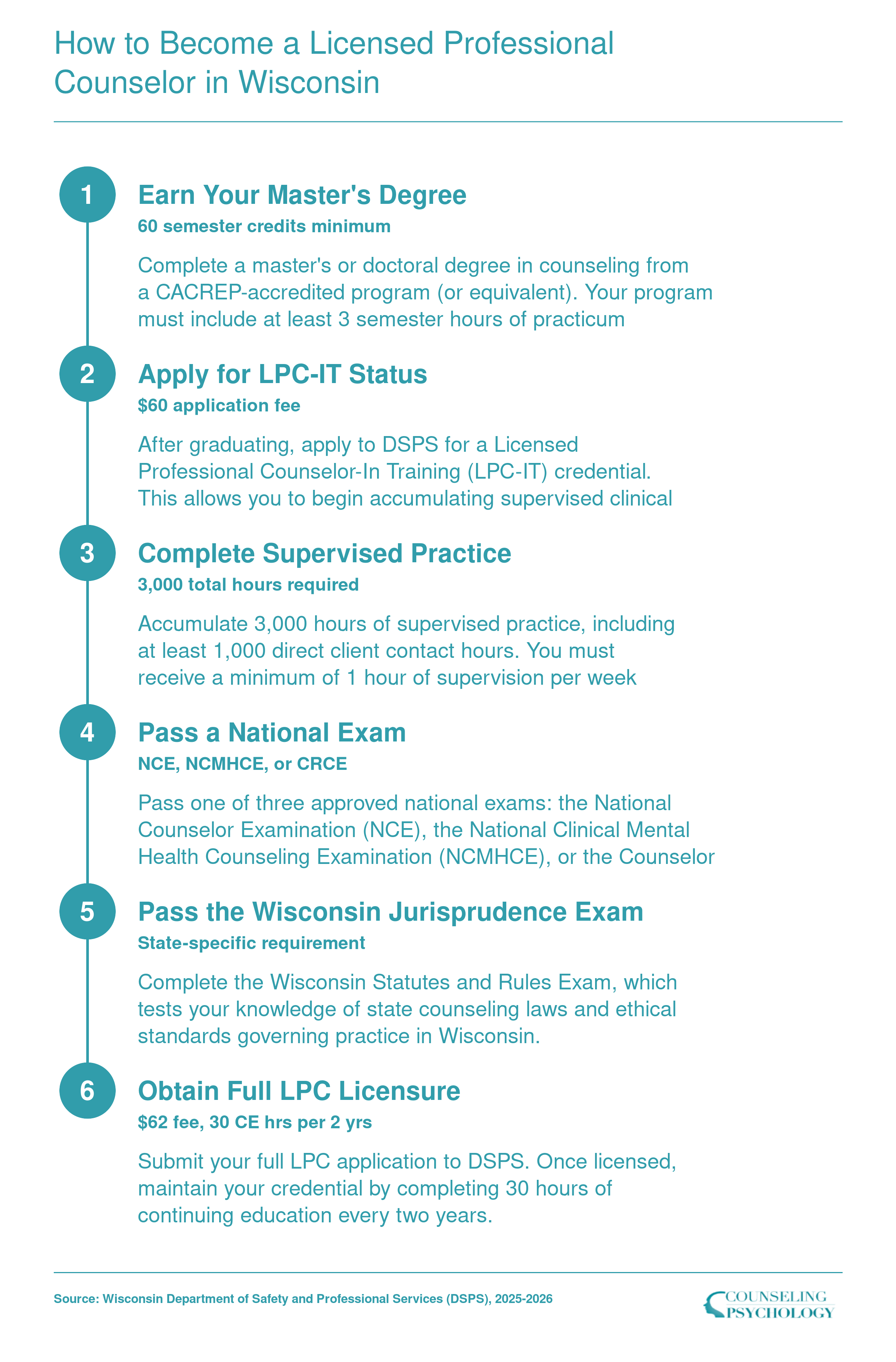
Wisconsin's path to full LPC licensure follows a clear sequence overseen by the Department of Safety and Professional Services (DSPS). The state accepts graduates of CACREP-accredited programs or programs deemed equivalent, and online program graduates face no additional requirements beyond what on-campus graduates must complete.
Accreditation and Licensure Details for Wisconsin LPC Candidates
Wisconsin requires 3,000 total supervised hours, including 1,000 direct client-contact hours, before you can practice independently as a Licensed Professional Counselor (LPC).1 That timeline shapes every decision you make about your master's program, from choosing CACREP-accredited schools to ensuring your practicum and internship meet state thresholds.
CACREP Accreditation and Why It Matters
The Council for Accreditation of Counseling and Related Educational Programs (CACREP) sets the national gold standard for counselor education. While the Wisconsin Department of Safety and Professional Services (DSPS) accepts regionally accredited master's degrees with equivalent coursework (60 semester credits covering eight core areas, a supervised practicum of at least 100 hours including 40 direct client hours, and a 600-hour internship including 240 direct hours), CACREP accreditation streamlines the process.1 CACREP-accredited programs are explicitly designed to meet these requirements, reducing the risk of having to document course-by-course equivalence during licensure review. Employers and reciprocity boards in other states also recognize CACREP credentials more readily, which matters if you ever relocate or pursue compact privileges. If you are still exploring program types, our overview of best online master's in counseling programs can help you compare options by accreditation status and format.
Online Degrees and DSPS Standards
Wisconsin DSPS does not distinguish between online and on-campus master's degrees for LPC licensure, provided the program meets accreditation and practicum standards.4 Your supervised clinical experiences must include face-to-face client interaction, which DSPS defines as either in-person or synchronous telehealth sessions.2 As long as your program arranges approved practicum and internship sites (many online programs partner with Wisconsin agencies or allow you to secure placements near your home), the delivery format itself does not disqualify you.
LPC-IT Supervision and Approved Supervisors
Once you graduate, you will register as a Licensed Professional Counselor in Training (LPC-IT) and begin post-graduate supervision. You need one hour of supervision per week, individual or group (maximum six supervisees), from an LPC or other eligible licensed mental health professional approved by DSPS.2 Full-time clinicians typically complete the 3,000-hour requirement in 1.5 to 2 years; part-time counselors may take 2.5 to 4 years.3 Use DSPS Form 2239 to secure supervisor approval before you begin accumulating hours, and submit Form 2464 (Supervisor's Affidavit of Applicant's Competencies) when you apply for full licensure.12 The Wisconsin Counselor Association and regional professional networks maintain directories of approved supervisors, though you are responsible for confirming eligibility with DSPS. Students pursuing accredited masters in mental health counseling programs should verify that their curriculum aligns with Wisconsin's eight core content areas well before graduation.
Interstate Reciprocity and the Counseling Compact
Wisconsin enacted the Counseling Compact during the 2025-2026 legislative session, joining a growing interstate agreement that allows LPCs to practice via telehealth across member states without obtaining multiple licenses.4 Full implementation timelines vary, so confirm current compact status and privilege-application procedures on the DSPS website before planning multi-state practice.
Wisconsin licensure doesn't strictly require a CACREP-accredited degree, but choosing one pays off later. CACREP graduates meet more employer hiring criteria, face fewer hurdles when transferring an LPC license to other states, and often see a smoother path through the licensure application itself. Treat accreditation as career insurance, not just a box to tick.
Earnings and ROI for Wisconsin Counseling Graduates
Investing two or more years and tens of thousands of dollars in a graduate degree means the return on that investment deserves honest scrutiny, not just optimism. The encouraging news for Wisconsin counseling graduates is that the state's wage floor for mental health counselors sits meaningfully above the national median, and the long-term outlook is among the strongest in the helping professions.
What Wisconsin Counselors Actually Earn
According to 2023 Bureau of Labor Statistics data, the state median annual wage for mental health counselors in Wisconsin is $62,470.1 That is notably higher than the national median of $59,190 reported for the same occupation in 2024. The range is wide: the bottom tenth percentile earns around $44,660 per year, while those in the top tenth reach $98,290.1 In the Northeastern Wisconsin nonmetropolitan area, the mean annual wage for this group is approximately $70,120, suggesting that rural and smaller-city markets are not necessarily lower-paying than you might assume.3
School counselors tend to earn somewhat more on average. The national median for school and career counselors was $65,140 as of 2024, and Wisconsin school districts generally follow salary schedules tied to teacher pay scales, which can provide more predictable annual increases.4
Specialization and Setting Shape the Numbers
Earnings vary considerably depending on where you work and what population you serve. Clinical mental health counselors in private practice or integrated health systems often out-earn those in community mental health counselor roles, though agency positions frequently come with loan forgiveness eligibility through programs like Public Service Loan Forgiveness. Substance abuse counselors typically start at the lower end of the pay range, though demand in Wisconsin remains high given the state's ongoing need for addiction services. Those interested in this track can explore addiction counseling online programs to compare curriculum options. School counselors in well-funded districts can build steady salary growth over a career.
Debt-to-Income Considerations
Program-level earnings data for the specific Wisconsin programs featured in this guide are not yet published through federal reporting channels, so direct program-by-program comparisons are not possible here. What is available is institutional-level median debt at graduation, which ranges roughly from $21,500 to $25,750 across the programs listed. Set against a starting salary in the $45,000 to $55,000 range that many early-career counselors report, that debt load is manageable by graduate school standards, particularly for graduates who pursue income-driven repayment or public service forgiveness pathways.
The Growth Argument
The Bureau of Labor Statistics projects 17 percent job growth for mental health counselors nationally through 2034, a rate nearly three times faster than the average across all occupations. Wage growth in the broader therapist category is projected at roughly 3 to 4 percent annually through 2030.5 For Wisconsin graduates entering the field in 2026, that trajectory means the salary picture five to ten years out looks considerably better than the entry-level numbers suggest. The investment calculus favors those who choose accredited programs, earn licensure promptly, and pursue counseling careers with built-in advancement.
Scholarships and Financial Aid for Wisconsin Counseling Students
Paying for a master's in counseling is a concrete, practical challenge, and Wisconsin students have more targeted funding options than many realize. Between university-specific awards, state and national scholarships, and federal repayment programs, a thoughtful aid strategy can meaningfully reduce what you borrow.
University and Program-Level Scholarships
Several UW campuses offer counseling-specific awards worth seeking out. UW-Superior awarded twelve scholarships of $5,000 each in Fall 2025 through its Future-Serving Behavioral and Mental Health program, with eligibility focused on students from historically marginalized backgrounds.1 UW-River Falls runs a cluster of named scholarships for its counseling students:2
- Mary J. Crownhart Scholarship: requires a minimum 3.0 GPA
- Richard James Baker Memorial Scholarship: for active-duty service members, reservists, veterans, or their immediate family, with a preference for those connected to the U.S. Air Force
- Ann Laufenberg Krupkat Scholarship: open to students who have completed COUN 610
- Therese Lachecki Memorial Scholarship: targets students pursuing the M.S.E. in School Counseling
- Carol Barry Memorial Scholarship: for students working toward the M.S.E. in Counseling
UW-River Falls also offers Graduate Student Grants for minority and disadvantaged students, covering tuition and fees at the Wisconsin resident rate plus books and supplies, for students enrolled in at least two credits. Two graduate assistantship positions are available each spring term, each carrying a commitment of roughly twelve hours per week.2
State and National Awards
The Wisconsin Counseling Association presents the Outstanding Counseling Graduate Student Award to a student currently enrolled in a Wisconsin counseling program.3 The Wisconsin School Counselor Association offers the Mike Troy Graduate Student Scholarship, aimed specifically at graduate students preparing to enter school counseling.4 The NBCC Foundation also funds awards open to counseling students nationally, including those in Wisconsin, so checking its current cycle is worth your time.
Federal Loan Repayment and Forgiveness
For counselors planning to work in public service roles, two federal programs stand out. Public Service Loan Forgiveness cancels remaining federal loan balances after ten years of qualifying payments while working full-time for a government agency, nonprofit, or public school. The National Health Service Corps Loan Repayment Program is a separate option for licensed mental health professionals who commit to serving in federally designated Health Professional Shortage Areas, which include a number of rural and underserved Wisconsin counties.
Wisconsin does not currently operate a broad state-level loan repayment program exclusively for mental health counselors, but federal NHSC designations cover many Wisconsin communities, so graduates willing to practice in those areas can access meaningful debt relief. Those interested in military-connected populations may also want to explore how to become a veterans counselor as a career path that pairs well with service-oriented loan forgiveness.
A Useful Comparison Tip
When comparing schools, look at the share of undergraduates receiving Pell Grants. A higher Pell share typically signals a school with a stronger culture of financial aid support and experience navigating funding for students with financial need. That institutional experience often extends to graduate programs as well.
How We Ranked These Wisconsin Counseling Programs
Choosing between the cheapest program and the highest-quality one is a false choice, and our ranking methodology reflects that belief. Rather than sorting schools by a single metric, the 2026 rankings on counselingpsychology.org blend affordability signals with outcome data so you can find programs that deliver real value.
What the Rankings Prioritize
Because the affordable filter is active for this list, net price and financial aid availability carry heavy weight in the scoring. Net price accounts for institutional grants, scholarships, and other aid that reduces out-of-pocket cost, giving you a clearer picture of what you will actually pay compared to sticker-price tuition alone. Programs that stretch aid dollars further rank higher.
Only online and hybrid programs appear in this list. If a Wisconsin institution offers its counseling master's exclusively on campus with no distance-learning option, it was excluded. This keeps the rankings relevant for working professionals and students outside major metro areas who need scheduling flexibility.
A Note on Graduation Rates
Graduation rates used here are institution-wide figures, not specific to the counseling program. That is a limitation worth naming. Program-level completion data is not consistently published across all schools. Still, an institution's overall graduation rate is a useful proxy: it reflects advising quality, student support infrastructure, and the school's track record of helping enrolled students finish what they started.
Earnings and Debt Data
Where the College Scorecard publishes program-level earnings and debt figures for a school's counseling graduates, those numbers are factored into the ranking. When that data is not yet available for a particular program, the school is evaluated on the remaining metrics rather than penalized for a reporting gap.
Editorial Independence
This ranking is updated for 2026 using the latest available federal and institutional data. Advertising relationships, sponsorships, and paid placements have no influence on a program's position. The goal is straightforward: give you an honest, data-informed starting point as you compare accredited masters in counseling in Wisconsin.
Frequently Asked Questions About Counseling Programs in Wisconsin
Below are answers to the questions prospective counseling students in Wisconsin ask most often. Each answer draws on the licensure requirements, program details, and career data covered throughout this article.